Is there a way to individually rotate photos?
Yes, use an editor with a rotation control to save a correctly oriented copy before repairing a visible mark. Cleanmark itself has no rotate button. Automatic interpretation of a camera's orientation tag is a different operation. In our controlled test, a tagged JPEG loaded in portrait orientation and the downloaded PNG kept that arrangement without keeping the original Orientation tag.
This answer concerns preparing a single image for browser watermark repair. It does not diagnose a photo-library upload or establish what an untested app release can do.
Encoded
Record dimensions and the Orientation tag separately.
Displayed
Check the actual loaded alignment before painting.
Downloaded
Inspect the saved pixels and tag again after export.
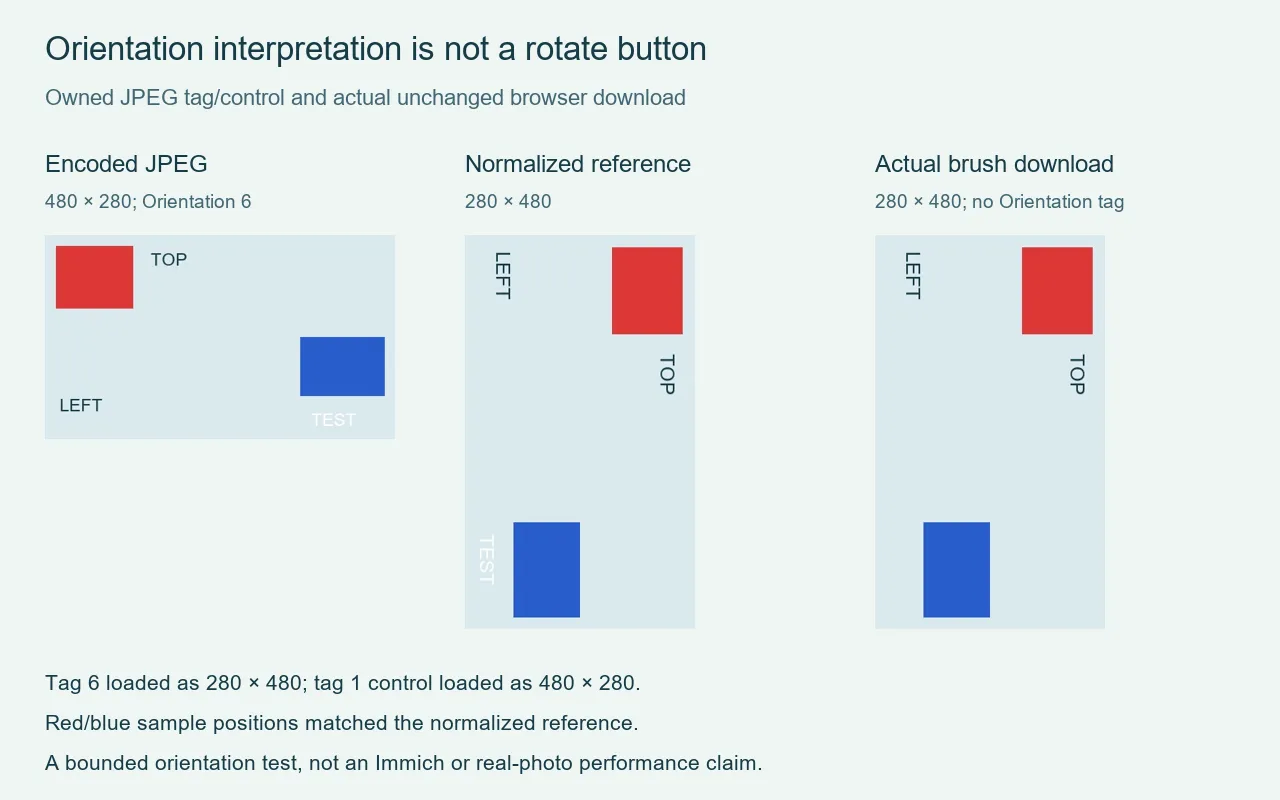
What happened to our tagged image
We made an owned asymmetric drawing measuring 480 by 280 pixels. A red block, blue block and TOP and LEFT labels made orientation visible. A small artificial TEST mark supplied a repair target. We saved JPEG copies with EXIF Orientation values 6 and 1. Their encoded dimensions were the same; the tag was recorded independently.
We created a reference from the decoded value-6 JPEG using Pillow's EXIF-transpose operation. The reference measured 280 by 480 pixels. This reference is not a simulated Cleanmark result. We then selected the actual tagged JPEG in the unchanged live tool. Its editing canvas measured 280 by 480, and the visible blocks and labels followed that portrait arrangement. The value-1 control later loaded at 480 by 280.
On the value-6 input we manually painted TEST, ran repair and used Download PNG. The actual saved output measured 280 by 480 and contained no EXIF Orientation tag. At the defined red sample coordinate, 230 by 60, both reference and output had RGB values 221, 55, 55. At the blue sample, 100 by 400, both had 41, 93, 203. The whole-image comparison found 1750 changed RGB pixels, so these matching sample positions must not be presented as complete pixel equality.
The output measured 23679 bytes. Its arrangement agreed with the normalized reference in this limited comparison even though the original Orientation tag was absent. That is evidence for this file and current loading/export path. It is not proof about every camera, phone, viewer or orientation value. We did not test a library's rotation interface or add a user-directed rotation feature.
Layout correction and saved pixels
Browser image-orientation documentation describes correcting orientation from EXIF information and distinguishes that from an arbitrary rotation. A display transformation alone should not be treated as evidence that a downloaded file's encoded pixels changed. Inspect the actual saved copy in the intended viewer.
Pillow documents EXIF-transpose as applying the orientation instruction and removing that instruction from the returned image. Our local reference used that operation; the browser result came from a separate real upload and download. Do not assume a missing tag always means a wrong picture, or that keeping a tag guarantees the intended display.
Before selecting a mark
Keep the untouched original. If the loaded alignment is wrong, prepare a properly oriented copy in an appropriate editor and reopen it before painting. This page supplies no third-party editor shortcut or current release promise. Verify the result from the saved copy, not only a thumbnail.
The browser watermark tool replaces a painted area with neighboring pixels. It does not run a generative model or recover the true hidden detail. Central marks require the manual brush; automatic edge mode is only a trial for small high-contrast edge marks. Edit only files you own or have permission to modify.
The dimension test covers a separate resizing limit. Swapped width and height after orientation interpretation must not automatically be described as lost resolution. Our fixture stayed below that tool's long-side cap, and this experiment does not establish photographic repair quality.