Or is there a fixed height to the watermark?
Do not assume a fixed pixel height for a saved attribution strip. We have not established a universal height. Inspect where the actual picture ends, crop only the separate border in an image editor, and keep the original. A mark printed inside the picture is a different case; removing bottom rows cannot isolate it safely.
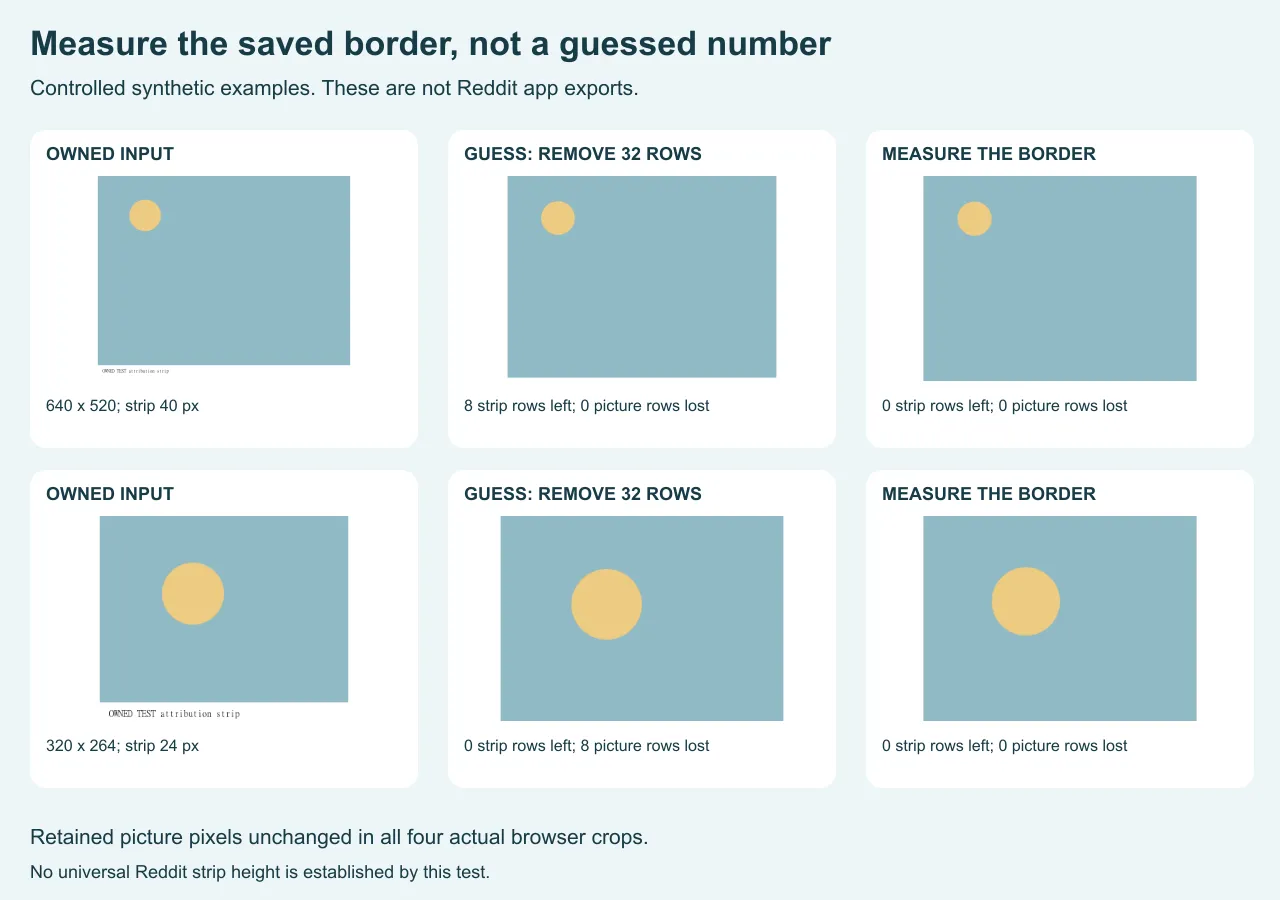
What the controlled crop actually did
We rendered two owned SVG fixtures into PNG images. The larger input measured 640 by 520 pixels: 480 picture rows followed by a 40-row artificial attribution strip. The smaller input measured 320 by 264 pixels: 240 picture rows followed by a 24-row strip. These sizes were chosen for a controlled comparison. They are not measurements of a Reddit app, a phone model, or a real downloaded post.
| Fixture | Remove 32 rows | Remove measured strip |
|---|---|---|
| 640 x 520 input | 640 x 488 output; 8 strip rows remain | 640 x 480 output; picture preserved |
| 320 x 264 input | 320 x 232 output; 8 picture rows lost | 320 x 240 output; picture preserved |
Each crop ran in a browser canvas and exported a PNG copy. The crop kept the original width and removed rows only from the bottom. We compared every retained picture pixel against the input, including its alpha value. All four crops changed zero retained picture pixels. That result describes the PNG files from this test; it does not promise that every editor or export setting preserves pixels.
The fixed crop was 32 rows in both files. For the larger fixture, the remaining strip was calculated as 520 minus 32 minus 480, giving 8 rows. For the smaller fixture, lost picture rows were 240 minus the output height of 232, also 8. Measuring the actual border gave 40 and 24 rows respectively, so neither measured crop removed picture rows or retained strip rows.
Find the boundary in your actual file
Open the original saved image at full size in an editor with a crop preview. Locate the last row of the picture and the start of the appended border. Preview a crop aligned to that boundary before exporting a copy. Do not count rows from a scaled screenshot or copy a value from another image. Check the subject near the edge and undo the crop if it removes useful detail.
The lesson from the comparison is about evidence, not a platform constant. Different fixture heights do not prove that a particular app varies its border. Equally, one apparently successful crop cannot prove a number is safe for every saved image. The exact border in the file you are editing is the useful measurement. If the boundary is unclear, we cannot supply a reliable crop height for that file.
When the mark is inside the picture
An interior mark has picture pixels around it rather than a separate appended band. See the in-image mark comparison. In Cleanmark, a central mark requires the manual brush; the automatic edge trial does not promise to find it. Nearby-pixel repair can leave blur or visible patches and does not reveal covered original detail. Use an image you own or have permission to edit.
For a disposable picture edge, the crop-versus-brush test shows the framing tradeoff. This page answers the narrower height question: measure this file's separate border instead of treating an unverified pixel number as a rule.