Does video watermark repair keep quiet and loud audio at different levels?
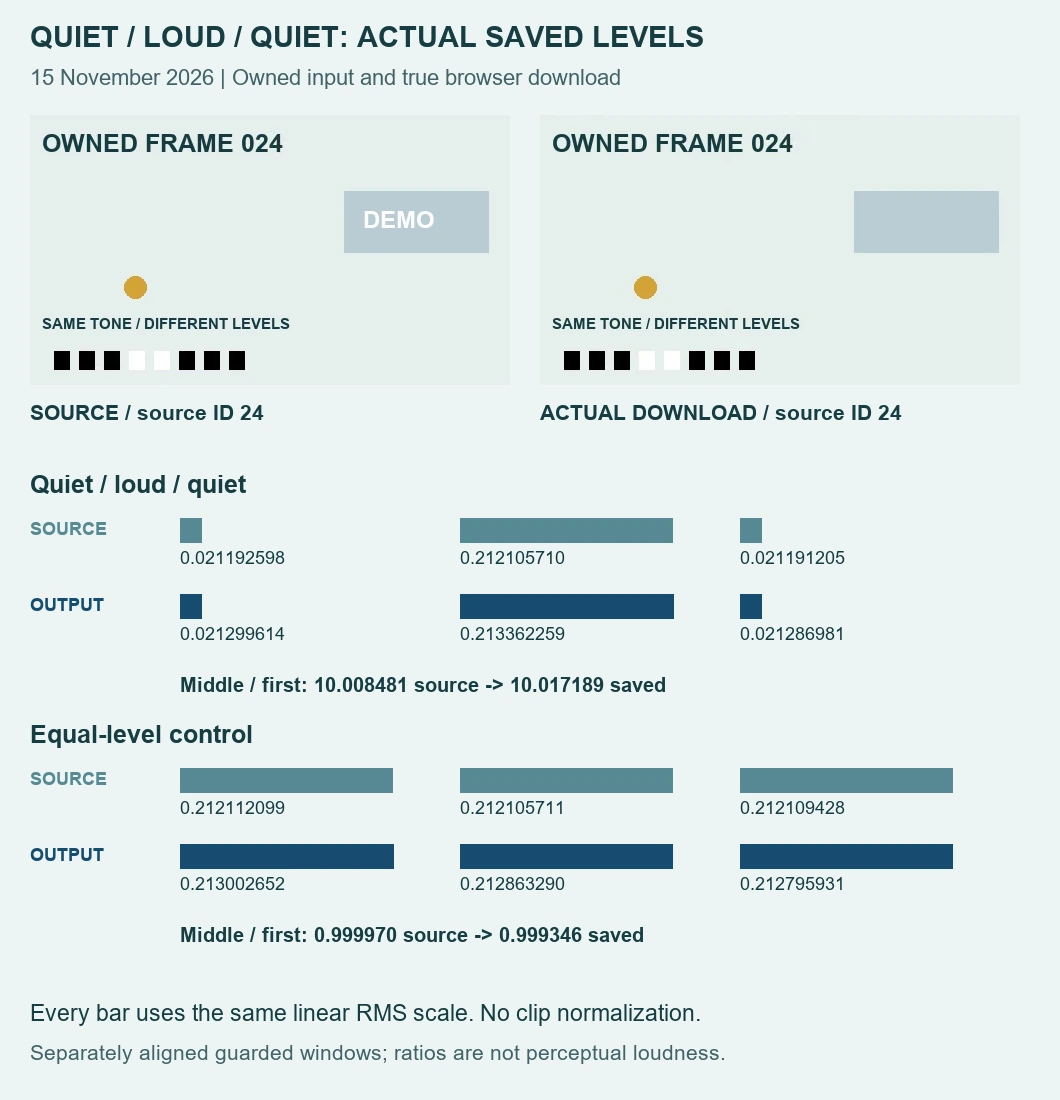
The quiet–loud–quiet contrast survived in our measured download: the middle-to-first RMS ratio was 10.017, compared with 10.008 in its encoded source. An equal-level control stayed near one. Absolute readings and timing changed, so this is evidence of retained level contrast in these windows, not an unchanged soundtrack.
Open the local video repair tool
Tested 15 November 2026 with new video and tones we own. Use authorized footage and keep the original. The tool estimates pixels inside a small selected area and records a new WebM; a clear patch does not certify every property of the sound.
A deliberate level change, not just sound present
We created two six-second, 480 × 270 MP4 inputs with the same new animation, a moving gold disk, binary frame identifiers and DEMO on a stationary patch. Each encoded video contained 144 frames, and every source identifier was verified after decoding. Both soundtracks used a generated 600 Hz tone in three separated active intervals. Each interval had short fades, leaving guarded interiors for measurement.
One source deliberately makes the middle interval louder than the outer two. The other uses equal intended levels throughout. We decoded the actual AAC inputs before repair rather than treating that waveform recipe as proof. The level-change input measured 88,371 bytes; its equal-level control measured 86,441. Both had one audio channel at 48,000 samples per second and a first decoded audio timestamp of zero.
For both real production-browser runs, Zone 1 covered X 324, Y 84, width 120, height 44 from zero to six seconds; Zone 2 stayed off. The box covered DEMO without covering the counter or moving disk. We used the unchanged tool, exported with the tab visible and downloaded each result. The saved files measured 196,715 and 204,431 bytes. Both fully decoded; neither was a simulated output.
Read the actual windows
Source interiors were 0.75–1.25, 2.75–3.25 and 4.75–5.25 seconds on the source timeline. Each output was aligned separately by its measured RMS envelope. The level-change run used a coarse +0.070-second shift; the equal-level control used +0.050. The table reports one saved channel because the two actual saved channels had identical readings in these windows. Both channel readings remain in the JSON.
| Case | First interior | Middle interior | Last interior | Middle / first |
|---|---|---|---|---|
| Level-change source | 0.021192598 | 0.212105710 | 0.021191205 | 10.008481 |
| Actual level-change repair | 0.021299614 | 0.213362259 | 0.021286981 | 10.017189 |
| Equal-level source | 0.212112099 | 0.212105711 | 0.212109428 | 0.999970 |
| Actual equal-level repair | 0.213002652 | 0.212863290 | 0.212795931 | 0.999346 |
How the comparison was measured
We decoded audio to floating-point PCM without downmixing, automatic normalization or loudness processing. Each sample’s time is its decoded audio frame timestamp plus its local index divided by the sample rate. RMS is sqrt(sum(x[n]²) / N), and absolute peak is max(abs(x[n])). The middle-to-first ratio divides the measured middle RMS by the measured first RMS. For the level-change output, that is 0.2133622588856937 / 0.021299613925517047 = 10.017189026608817. These are amplitude measurements, not subjective loudness scores or probabilities.
For alignment, we formed combined-channel RMS envelopes in global ten-millisecond bins containing actual samples. We tested shifts from −250 to +250 milliseconds in ten-millisecond steps and chose the highest Pearson correlation. The selected correlations were 0.999909805 and 0.998538594. The full candidate scores are downloadable. This finite-grid estimate places our guarded windows; it does not establish exact audio/video synchronization or justify matching arbitrary clips.
The saved level-change interiors contained 23,975, 24,024 and 24,000 samples per channel. The control interiors contained 23,976, 24,192 and 23,976. Actual decoded timestamp steps included gaps or overlaps relative to contiguous sample timing, reaching absolute discrepancies of 0.0105 and 0.011 seconds. We kept the actual timestamps, sample counts and raw readings rather than silently concatenating PCM and calling every window exactly 24,000 samples.
What did not stay unchanged
The sources were mono AAC; both downloads were stereo Opus. Video frame counts fell from 144 to 138 and 139. The first saved audio timestamps were 0.033 and 0.045 seconds. Saved audio contained 288,000 and 285,120 samples per channel, or 6.000 and 5.940 seconds of samples at 48,000 Hz. Sample duration is not the same as timestamp span.
The maximum absolute decoded output peaks were 0.305359721 and 0.303998381. No decoded sample reached full-scale magnitude one, but that alone cannot certify freedom from every distortion. Absolute RMS changed, and even the equal-level control’s ratios were not exactly one. We did not isolate a gain-control or codec cause. The narrow conclusion is that the intended strong contrast remained in this pair’s measured interiors.
Check a clip before accepting its sound
- Keep an authorized original and identify quiet and loud passages you need to preserve.
- Repair only the supported small visible mark, download the result and inspect that saved file.
- Compare corresponding guarded passages at the same playback-volume setting. For measurements, avoid independently normalizing the files; that can hide an overall level change.
- Check the ending, channel content and timing separately. Reject a result that fails the property your project needs.
This differs from the left/right separation test, which checks different material in two channels. The late-start audio test checks event timing. Neither a stereo label nor an audible tone answers the level-contrast question by itself.
Inspect the files and raw readings
Owned level-change input · Actual level-change download · Owned equal-level control · Actual control download · Complete output measurements · Encoded input verification
These tones make one controlled contrast easy to inspect. They do not establish the behavior of all speech, music, browsers or devices. A saved-file check should answer the property you actually need, while keeping the original available.