Does video watermark repair keep left and right audio separate?
The left and right signals stayed distinct in our measured browser-export windows. A left-only tone remained on the left, a right-only tone remained on the right, and the simultaneous-tone sample kept different dominant frequencies in each channel. The saved recording was not a bit-for-bit soundtrack copy, and these measurements do not promise perfect isolation or exact synchronization.
Open the local video toolInspect the source and saved result
A stereo label or audible sound alone does not answer this question. Check the two decoded channels separately, especially when each side carries different material.
A new source with deliberately different channels
On 5 November 2026 we generated and own a six-second animation with a moving gold disk, visible frame counter, audio-window labels and a small DEMO target on a plain patch. Its 144 source frames run at 24 frames per second. The video is 480 × 270 pixels. A separate generated stereo waveform supplies a 440 Hz tone on the left and an 880 Hz tone on the right, with silent guard intervals between the active windows. No downloaded platform video or third-party soundtrack was used.
From 0.5 to 1.5 source seconds only the left channel is active; from 2.5 to 3.5 only the right is active; from 4.5 to 5.5 both carry their different tones. The generated waveform uses short fades at the boundaries. We encoded an MP4 with AAC audio, then decoded that actual input before testing. Its measured left-only interior had left RMS 0.212068289 and right RMS zero. The right-only interior had left RMS zero and right RMS 0.212089760. This verified the encoded source, rather than assuming the waveform recipe survived encoding.
The input measured 127,128 bytes and loaded in the existing production tool at 480 × 270 and 6.000 video seconds. We selected Zone 1 X 296, Y 103, width 94 and height 38, active from zero to six seconds; Zone 2 stayed disabled. The box covered DEMO, away from the counter and moving disk. We exported in the actual browser and downloaded the new WebM. No tool code or existing page was changed to obtain the result.
The saved result measured 257,057 bytes and contained VP9 video and stereo Opus audio. Both source and output passed complete decoding. Extracted output frames at one, three and five playback seconds retained the frame dimensions and showed the selected lettering absent. At five seconds the saved picture reads FRAME 121; the comparison below uses source frame 121 too, not an assumed match to source playback time five seconds.
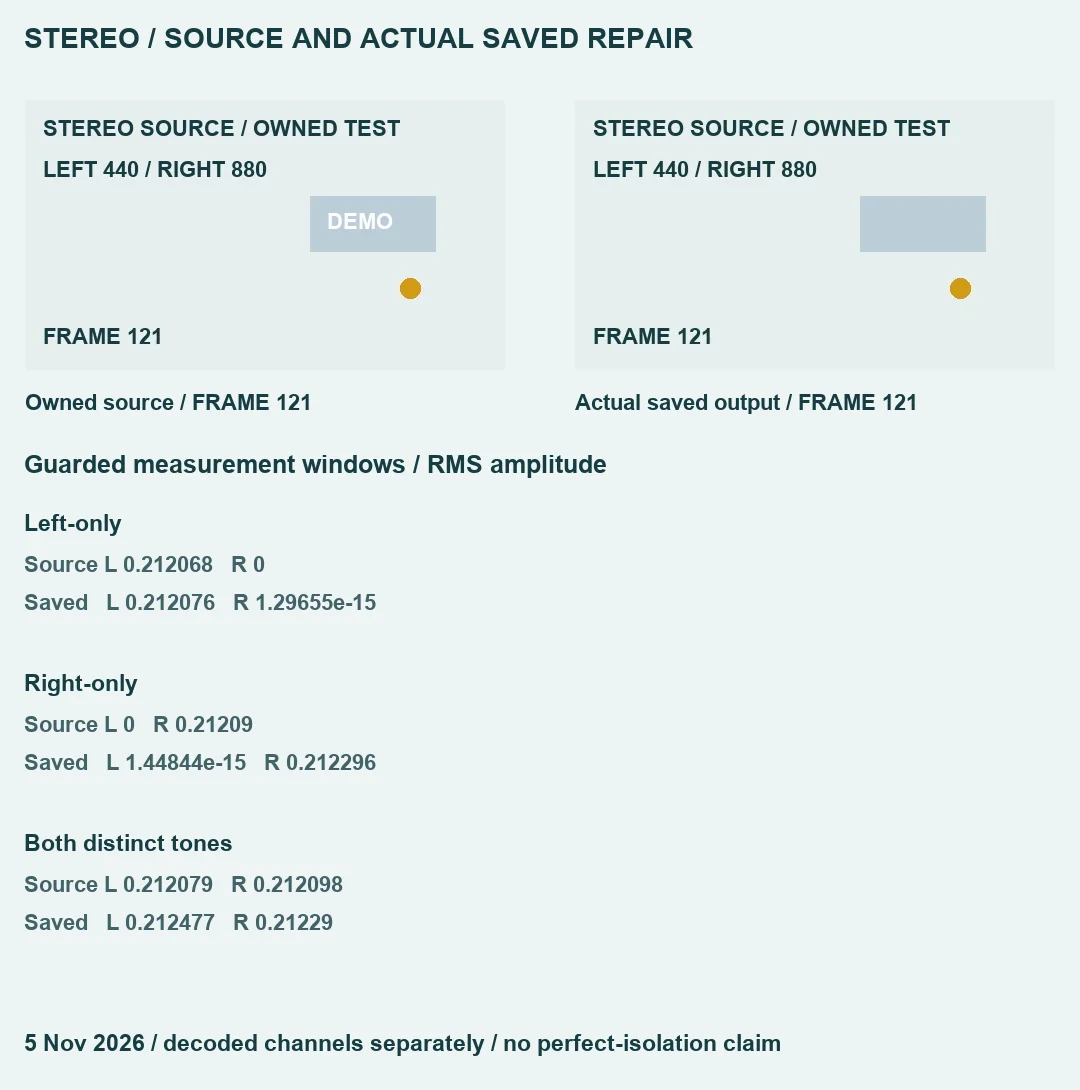
Measure the windows after checking the recording offset
We decoded source and saved audio to floating-point PCM at 48,000 samples per second, retaining both channels without downmixing. To estimate a coarse audio offset, we compared their combined-channel RMS envelopes in 10-millisecond bins, choosing the lag with the highest Pearson correlation over candidate lags from minus to plus 250 milliseconds. The best grid position put the saved envelope 40 milliseconds later. This is a grid-based alignment estimate, not an exact audio/video synchronization measurement.
Each source measurement uses a half-second interior window, away from transitions. Each saved measurement shifts that window by the estimated 0.040 seconds. Every window contains 24,000 samples per channel. RMS is sqrt(sum(x[n]²) / N), with PCM amplitudes normalized to full scale 1. Displayed table values are rounded; the linked JSON retains full readings and alignment candidates. No universal pass threshold was invented.
| Signal window | Source time | Source L / R | Saved time | Saved L / R |
|---|---|---|---|---|
| Left only | 0.75–1.25 s | 0.212068289 / 0 | 0.79–1.29 s | 0.212076201 / 1.29655 × 10⁻¹⁵ |
| Right only | 2.75–3.25 s | 0 / 0.212089760 | 2.79–3.29 s | 1.44844 × 10⁻¹⁵ / 0.212295820 |
| Both distinct tones | 4.75–5.25 s | 0.212078863 / 0.212097594 | 4.79–5.29 s | 0.212476706 / 0.212289816 |
The saved opposite-to-wanted RMS ratio was approximately 6.11360 × 10⁻¹⁵ for the left-only window: right RMS divided by left RMS, using the full values 1.2965487680668105 × 10⁻¹⁵ and 0.21207620117584328. For the right-only window it was approximately 6.82276 × 10⁻¹⁵: left RMS 1.4484427332373337 × 10⁻¹⁵ divided by right RMS 0.2122958202036645. These are measured window ratios, not success probabilities. Tiny nonzero values are retained; their cause was not isolated, and they are not a promise of mathematically perfect silence.
In the simultaneous-tone window, the dominant frequency remained 440 Hz on the left and 880 Hz on the right in both files. We located the largest magnitude of a Hann-windowed FFT; the window length gives 2 Hz bin spacing. This identifies the dominant tones in this fixture, not every spectral component, original encoding or music-quality characteristic.
Decoded source audio contained 288,768 samples per channel, or 6.016 seconds at 48,000 samples per second. The saved audio contained 288,000, or 6.000 seconds. Duration is sample count divided by sample rate. Together with changed RMS values and the offset estimate, this is a reason to avoid calling the recording an exact soundtrack or timing copy.
Download the actual stereo input, actual downloaded repair and measurements, formulas and hashes. The browser input record retains loaded dimensions and rectangle settings. Our conclusion is limited to this generated file, browser workflow and measured windows; it does not establish every multichannel layout or viewer.
Check your own saved audio
- Keep an authorized original. If different voices or other important material occupy each side, inspect those channels separately before and after editing.
- Use the local repair tool only for the small visible mark it can address. A successful image patch does not certify unchanged sound.
- Save the result and check left/right placement, transitions and the ending in the intended viewer. Do not rely only on a stereo badge or a waveform mixed to mono.
- If the recording loses, mixes or swaps material you need, reject it and return to an authorized original or a workflow whose saved audio you have verified.
This is separate from portrait orientation
The portrait-video experiment checks stored pixels, a display matrix and upright output. Its mono tone cannot establish stereo separation. Here the new evidence is a verified independently signaled input, a real saved repair and separately decoded left/right measurements. Neither experiment certifies all of the other recording properties.