Does video watermark repair keep the pitch of a 44.1 kHz soundtrack?
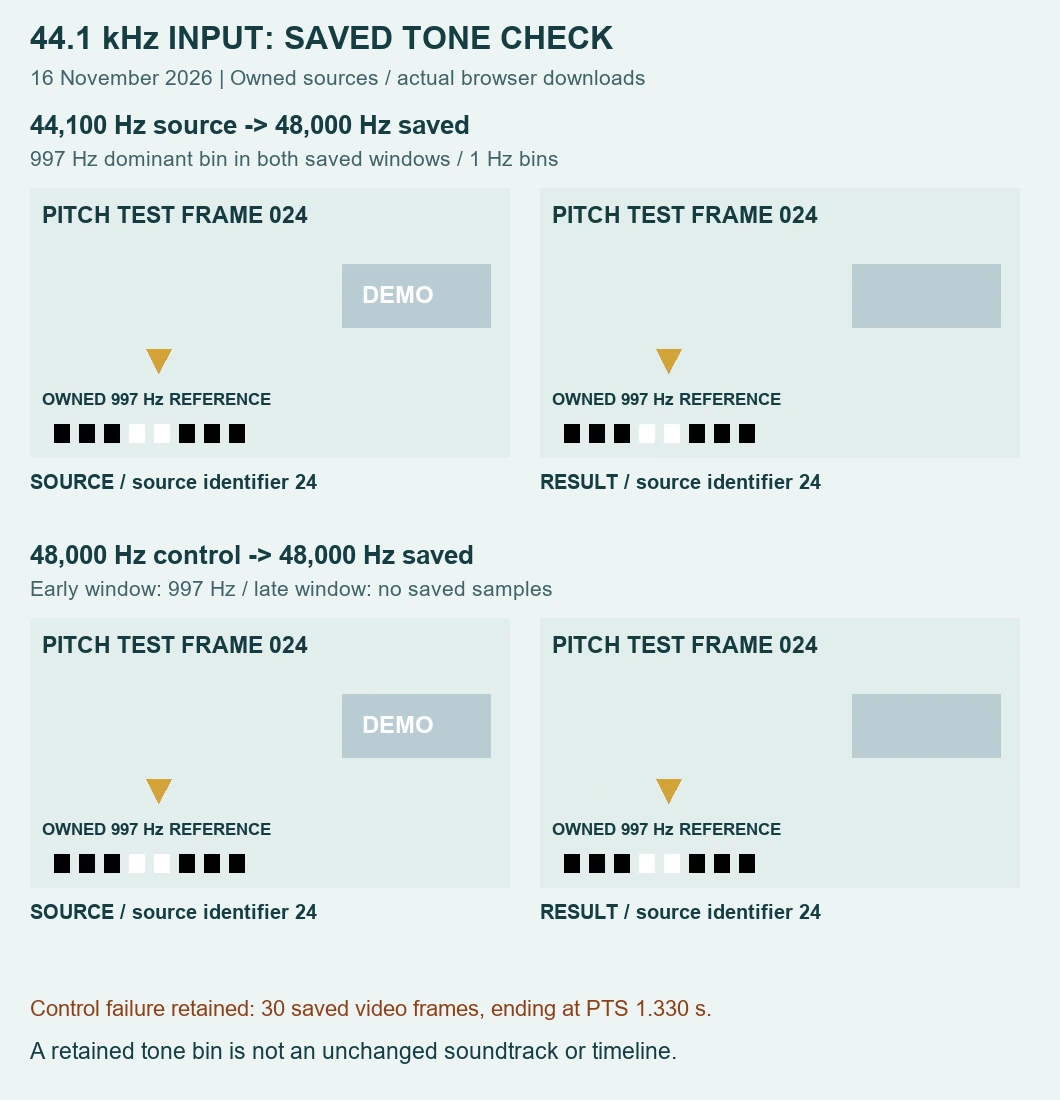
The dominant tone stayed in the 997 Hz bin in both measured windows of our 44.1 kHz input’s actual repair, even though the saved audio was 48 kHz. That supports retained tone frequency at this test’s one-hertz bin spacing. It does not establish an unchanged soundtrack: the separate 48 kHz control ended early and had no late window to measure.
Open the local video repair tool
Actual browser test: 16 November 2026. These are new synthetic videos and tones we own, not downloaded platform footage. Edit only authorized media and retain the original. The tool estimates covered picture detail and records a new WebM.
Verify the input before interpreting the download
We generated two new four-second videos with the same 480 × 270 animation, a moving triangle, an encoded frame identifier and a small DEMO patch. Each source contained 96 video frames. Every identifier from zero through 95 was verified after decoding, rather than assumed from the animation recipe.
The first file carries a genuinely encoded mono AAC soundtrack at 44,100 samples per second. The separate control carries mono AAC at 48,000. Both use the same intended 997 Hz tone, active from 0.5 to 3.5 seconds with short fades. We generated each waveform at its intended sample rate and decoded the actual MP4 before testing. We did not rename a header or reinterpret the samples to manufacture a pitch change.
The inputs measured 76,437 and 75,692 bytes. Both decoded frequency windows had their largest Hann-windowed FFT bin at 997 Hz. Their decoded audio contained 177,152 and 192,512 samples respectively, including encoding preparation effects. Those counts divided by their own sample rates are not assumed to be exactly the four-second video duration.
Two unchanged-tool runs, including a failed control
Both original files loaded in the production tool at 480 × 270 and 4.000 video seconds. Zone 1 was X 323, Y 84, width 122, height 46, active from zero to four seconds; Zone 2 stayed off. The repair box covers DEMO away from the counter and triangle. Each actual run reached Ready and supplied a downloaded WebM. We did not modify the tool, inject a pitch control or substitute an offline repair.
| Case | Source rate | Saved rate / channels | Saved bytes | Saved video frames |
|---|---|---|---|---|
| 44.1 kHz source | 44,100 Hz, mono | 48,000 Hz, stereo | 127,144 | 92 |
| 48 kHz control | 48,000 Hz, mono | 48,000 Hz, stereo | 49,079 | 30 |
All sources and downloads decoded completely, but successful decoding does not mean the whole intended recording survived. The control’s last video frame was source identifier 32 at saved timestamp 1.330 seconds. Its saved audio provided no samples at or after our requested late-window start of 2.250 seconds. We kept that file and label the late measurement unavailable.
What the measured frequency actually means
We decoded each audio stream to floating-point PCM at its actual native rate, without a resampling filter, normalization or downmixing. For a requested start of 0.750 or 2.250 seconds, we located the first sample at or after that decoded timestamp, then took N consecutive samples, where N equals the decoded sample rate. A Hann-windowed real FFT therefore has bin spacing fs/N = 1 Hz. No zero-padding was used to imply finer physical resolution.
| File | Early window | Late window | N per channel |
|---|---|---|---|
| 44.1 kHz input | 997 Hz | 997 Hz | 44,100 |
| Its saved repair | 997 / 997 Hz | 997 / 997 Hz | 48,000 |
| 48 kHz input control | 997 Hz | 997 Hz | 48,000 |
| Saved control | 997 / 997 Hz | Unavailable | 48,000 early only |
Saved stereo entries list left and right separately. The first 44.1 kHz result window’s peak magnitude was 2997.618552 at 997 Hz, compared with neighboring-bin magnitudes 1499.337785 at 998 Hz and 1497.477668 at 996 Hz. The raw top bins, indices and readings remain downloadable. A largest bin is not proof of exactly unchanged pitch to arbitrary precision, nor a general music-quality assessment.
The second window of that result also had its largest bin at 997 Hz in both channels. The control’s early window did too. We have no control late-window value: no tone, zero hertz and an unavailable measurement are different statements. The saved sample-rate label alone was never used as evidence that pitch stayed fixed or changed.
Timing and completeness remain separate checks
Each sample’s container position was recorded as decoded audio-frame timestamp plus local sample index divided by sample rate. The first result’s early sample window ran from timestamp 0.750 to 1.749979; its late window from 2.250 to 3.249479. The control’s early window ran from 0.750 to 1.751979. Consecutive samples on the sample axis do not guarantee a perfectly contiguous container timeline: decoded timestamp-step discrepancies reached 0.011 and 0.010 seconds relative to adjacent sample durations.
Using ten-millisecond global timestamp bins and a fixture-specific RMS threshold above 0.03, both inputs showed tone activity from 0.50 to 3.50 seconds. The 44.1 kHz result’s activity occupied 0.58–3.57; the short control occupied 0.55–1.84. These bin ranges describe observed activity, not exact audio/video synchronization, a universal audibility limit or proof of playback speed.
The 44.1 kHz result has 192,960 decoded audio samples per channel, while the short control has 86,400. At 48,000 Hz that is 4.020 and 1.800 seconds of samples. Both changed from mono AAC to stereo Opus. The first result’s last video frame was identifier 95 at timestamp 3.982; the control stopped much earlier. We did not isolate why the control ended early, and we did not replace it with a better-looking retry. Retained frequency in available windows does not rescue missing content.
Check the property your edit needs
Keep an authorized original, export a short sample and inspect the actual download, including the ending. Check recognizable sound and picture events separately from frequency. If a recording truncates, reject it even when the available tone sounds plausible. Our quiet/loud test measures amplitude contrast; the stereo test measures channel separation. Neither substitutes for this different-rate input check.
Download the complete evidence
Owned 44.1 kHz input · Actual repair · Owned 48 kHz control · Retained short control · Input verification · Full saved-file measurements
This pair supports a narrow answer about a generated tone in one browser workflow. It cannot certify all voices, music, codecs, devices or file timelines.