Does video watermark repair keep a second selectable audio track?
No: neither saved result retained two separately selectable audio tracks. Each two-track input became one stereo Opus stream. With track A marked default, both saved channels had a 440 Hz dominant tone; changing the default to track B changed both to 880 Hz. Hearing sound, or seeing “stereo,” did not mean the alternate track survived.
Open the local video repair tool Inspect both controls and saved files
Tested 8 November 2026 with new owned animation and generated tones. This is a selectable-stream check in the actual browser export workflow, not a test of every container, language selector or soundtrack layout.
Two audio streams are different from two channels
We made a new three-second 480 by 270 animation containing a moving triangle, a source-frame counter and DEMO on an isolated plain patch. Its 72 video frames were decoded and every counter from 0 to 71 verified before testing. The input has two separate mono AAC streams: track A carries a generated 440 Hz tone and track B carries 880 Hz. These are separate streams in one MP4, not left and right channels relabeled as separate tracks.
Two control files each measured 102,646 bytes. In default-A.mp4 the first audio stream is marked default; in default-B.mp4 the second is marked default. We decoded both videos and each corresponding audio stream explicitly. Those decoded video and PCM bytes matched between controls; only two container bytes differed. Stream metadata and the actual default flags were checked, rather than inferred from the filenames.
The streams have language tags to identify the controls, but contain tones, not English or Chinese speech. Each encoded input audio stream decoded to 144,384 samples at 48,000 samples per second, or 3.008 seconds. The input waveform recipe alone was not accepted as proof that both encoded tracks had survived.
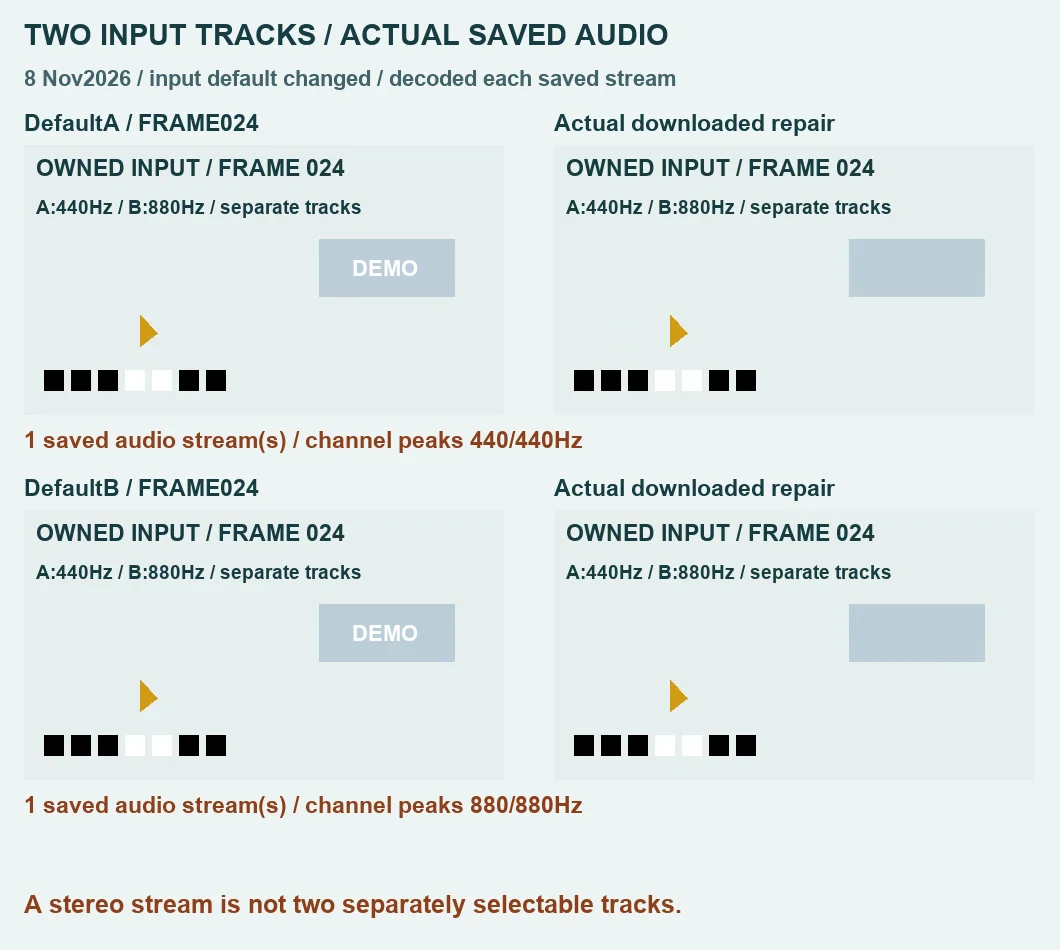
Same repair rectangle, different default track
We selected each original MP4 in the unchanged production tool, without adding an audio selector or changing its code. The source loaded at 480 by 270 and 3.000 video seconds. Zone 1 used X 318, Y 105, width 91 and height 38 pixels from zero to three seconds. Zone 2 stayed off. The rectangle covered DEMO without covering the source counter or moving reference.
We actually exported, downloaded and decoded both WebM files. The default-A result measured 111,232 bytes and the default-B result 106,242 bytes. Both retained 480 by 270 video. They decoded to 68 and 64 video frames respectively, so the experiment does not claim an unchanged timeline. Our matched illustration uses the source counter rather than assuming equal output-frame indices or playback seconds.
| Source default | Separate source audio streams | Separate saved audio streams | Saved channels | Dominant L / R tone | Decoded audio |
|---|---|---|---|---|---|
| A | 2 | 1 | 2 | 440 /440 Hz | 3.000 s |
| B | 2 | 1 | 2 | 880 /880 Hz | 3.000 s |
What the saved sound actually contained
Each saved file contained exactly one audio stream, reported as stereo Opus at 48,000 Hz. We decoded it without downmixing. Each channel contained 144,000 samples:144000/48000=3.000 seconds. Two decoded channels inside that one stream do not give the viewer two independently selectable soundtracks.
For content measurements, we used sample indices 24000 through 71999 in each saved channel. That is 48,000 samples, an interior window away from the source fades. RMS is sqrt(sum(x²)/N). A Hann-windowed FFT at 48,000 Hz with N=48,000 gives 1 Hz bin spacing; the largest-magnitude bin identifies the dominant tone. This steady-tone check is not a sample-accurate audio/video alignment measurement.
With source A default, both output channels had RMS 0.17663478317425185 and a 440 Hz dominant peak. Its 440 Hz FFT magnitude was 2997.2440365746957, while the 880 Hz bin was 0.10837498685391429. With source B default, both output channels had RMS 0.17759302733177923 and an 880 Hz dominant peak. Its 880 Hz magnitude was 3016.001335423219, while the 440 Hz bin was 0.0016303461477222554. The raw readings remain in the linked JSON; small other-bin values are not rounded into perfect absence.
The combined observations establish the useful limitation: neither export retained an independent alternate stream, and the dominant saved content followed the default flag in these controls. We did not isolate the cause of tiny other-bin energy or certify that no artifact exists anywhere in the audio. Nor did we prove how a different browser or a file with speech will choose a track. This is an observed pair of recordings, not a universal default-selection rule.
Sound present is not all soundtracks preserved
Both complete source files and both saved outputs decoded successfully. In the shown saved frames the DEMO text is absent, but that picture result does not rescue the missing alternate-stream choice. We kept both output files instead of presenting the one whose tone happened to be wanted as evidence that every soundtrack had survived.
The input's decoded audio lasts 3.008 seconds and the saved recording 3.000 seconds. Codec and channel layout also changed. Those differences are why this page does not describe the result as a lossless soundtrack copy or promise exact synchronization. A language label on an input is not evidence that the saved file still offers that language as a separate choice.
Our earlier stereo experiment asks whether left and right signals within one stream stay separate. This experiment asks whether a second stream remains selectable after export. A file can pass the first question while failing the second. Keeping the two acceptance checks separate avoids treating the word “stereo” as a substitute for inspecting the actual file structure.
Check your own alternate soundtrack before editing
- Keep an authorized original containing every soundtrack you need.
- Identify whether your file has separate selectable streams or merely multiple channels inside one stream.
- If you try this local repair, download the real result and inspect its soundtrack choices in your intended viewer.
- Check audible content, stream count and the ending independently. A successful repair thumbnail or a sound icon is not enough.
- If an alternate track is required and the saved file lacks it, keep the original and use a workflow whose actual exported tracks you have verified.
Does this replace the left/right audio test?
No. The left/right signal test measures channels inside one stream. The portrait orientation test measures upright pixels. Neither establishes retention of independently selectable soundtracks.
Download the complete controls and results
- Owned source with A default and actual saved result
- Owned source with B default and actual saved result
- Saved stream enumeration, channel readings and hashes
- Input stream verification and decoded control equality checks
These are generated test assets we own. The page adds a saved-file acceptance check, not an audio-track selector, platform downloader or permission to edit someone else's footage.