Does video watermark repair change colors outside the selected area?
Yes, in our measured files: color patches outside the repair changed. The largest measured RGB-component difference was 27 in the BT.709-input run, even though those patches were nowhere near the DEMO rectangle. The second input's largest difference was 2. Keeping the frame dimensions and clearing the lettering did not establish identical color.
Open the local video repair tool Inspect the actual files and readings
Actual exports tested 8 November 2026, completing the 7 November task. These owned SDR fixtures measure decoded values in this browser workflow. They are not a calibrated perceptual-color test, an HDR test or proof of one cause inside the pipeline.
Compare untouched patches, not only the repaired label
We made two new three-second 480 by 270 animations. Eight color patches and eight neutral patches sit above an isolated DEMO label. A moving triangle and visible source counter identify matching moments. The video has 72 source frames; all source counters were decoded and verified before testing. Both inputs are deliberately silent. No platform footage, old export or stock photograph was used.
One MP4 uses a verified BT.709 matrix with limited-range tags and measures 25,080 bytes. The other uses a BT.601 matrix, with SMPTE 170 M tags, and measures 25,551 bytes. We preserved actual encoded YUV patch readings separately from decoded RGB. The uncompressed drawing is not the compressed-input baseline. Different primaries and transfer tags do not make these encodes a calibrated pair of perceptually identical videos; each result is compared with its own decoded input.
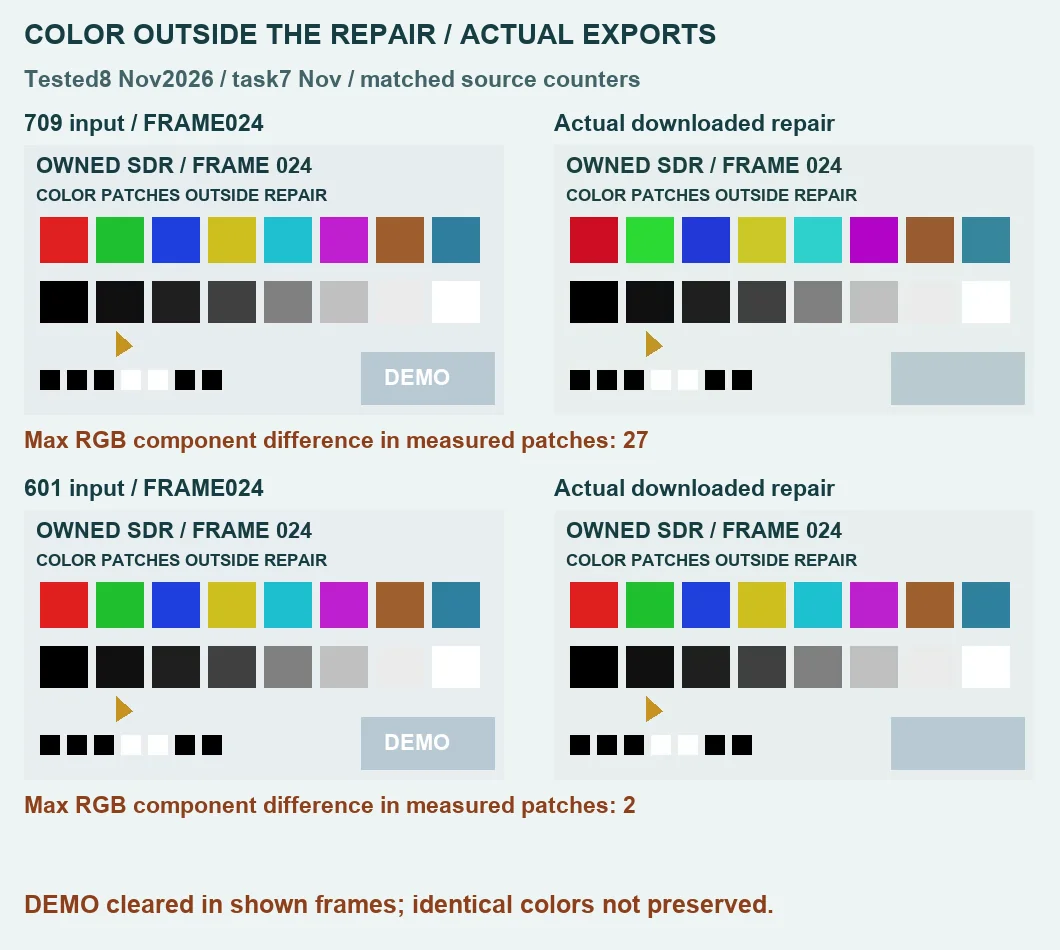
The rectangle stayed away from the measured colors
We selected each original file in the unchanged production tool. Zone 1 started at X 352 and Y 214, with width 97 and height 38 source pixels, active from zero to three seconds. Zone 2 stayed disabled. That box covered the white DEMO letters on the lower-right plain patch. None of the measured color or neutral patch centres fell inside it.
The first BT.709 export returned the exact message “Export was empty.” and produced no downloadable result. We retained that attempt's status record. A retry of the same input produced the actual saved file used below. The second input produced its own downloaded result. We did not replace the failed attempt with a claim that every click worked, or count it as a color result.
The saved files measured 58,726 and 81,823 bytes respectively. Both decoded completely as 480 by 270 VP9 video with an Opus audio stream. The inspected matched frames show DEMO replaced by the surrounding plain patch. The BT.709-input result contains 57 decoded video frames and the other 70, against 72 in each source. This is not an exact-timing or sample-complete copy; equal playback seconds are not assumed to match.
Actual values outside the box
For each output we chose saved frames nearest source counters 24,48 and 66, then matched the decoded input by the burned-in counter. Each sample contains 16 patch centres. We compared nine-by-nine pixel interiors, away from edges and chroma transitions. The maximum absolute component difference across those measured patches was 27 for the BT.709 input and 2 for the BT.601-matrix input. These are bounded sample extrema, not a whole-video quality score or an invented pass threshold.
| Input | Patch | Input mean RGB | Saved mean RGB | Largest component difference |
|---|---|---|---|---|
| source-709.mp4 | red | 223, 32, 32 | 205, 13, 35 | 19 |
| source-709.mp4 | green | 30, 191, 47 | 44, 218, 53 | 27 |
| source-709.mp4 | blue | 30, 63, 222 | 34, 56, 214 | 8 |
| source-709.mp4 | neutral 128 | 128, 128, 128 | 128, 128, 128 | 0 |
| source-601.mp4 | red | 223, 31, 30 | 222, 32, 30 | 1 |
| source-601.mp4 | green | 32, 191, 47 | 31, 192, 47 | 1 |
| source-601.mp4 | blue | 30, 63, 223 | 31, 64, 221 | 2 |
| source-601.mp4 | neutral 128 | 128, 128, 128 | 128, 128, 128 | 0 |
For example, the BT.709-input green patch changed from 30,191,47 to 44,218,53. The green-component difference is 218−191=27. Its red patch changed from 223,32,32 to 205,13,35. A neutral patch remaining unchanged would not cancel those colored-patch differences. The second input's selected blue patch changed from 30,63,223 to 31,64,221, including a blue-component difference of−2.
For each pixel and RGB component, signed difference is saved value minus decoded-input value. Mean absolute component error is sum of the absolute differences divided by 9×9×3 for one patch. Averaging the 48 measured patch errors yielded 4.9375 in the BT.709-input result and approximately 0.416667 in the second result. The linked JSON retains all three matched moments, individual means, signed differences and maximum differences. These calculations use decoded 8-bit values; they are not a probability, a percentage of visual quality or a perceptual-distance model.
Separate a measured change from an explanation
We explicitly decoded each input using its verified limited-range matrix, then decoded the saved output according to its stored tags. The saved files reported full-range BT.709 video with an sRGB-style transfer tag. That tag change is a record of the output, not proof that one particular conversion caused the observed RGB change. Browser decoding, canvas color handling and lossy recording were not isolated in separate experiments.
The test does not establish that converting every video to the second input's encoding will fix color. Its smaller measured differences belong to this file and run. No display calibration or independent colorimeter was used. We also did not measure HDR, a phone recording, photographic skin tones, every pixel of every frame, or the perceptual acceptability of your own file. Both silent inputs gained recorded audio streams, but this is not a meaningful-sound preservation check.
The useful result is narrower: inspect wanted material outside the selected patch too. In these saved files, clearing the visible label did not keep all measured colors identical. Keeping the actual inputs, outputs and matching source counters makes that distinction auditable instead of relying on a clean-looking thumbnail.
Before replacing an original
- Keep an untouched file you own or may edit.
- Inspect important colors away from the watermark as well as the repaired patch.
- Download the actual export and reopen it in your intended viewer. A browser preview alone is not the saved result.
- Use a controlled decoded reference when color values matter; distinguish encoding differences from a calibrated visual judgment.
- If the color changes are unacceptable for your work, retain the original. This test supplies no lossless-color guarantee.
How is this different from the gradient test?
The smooth-gradient experiment tests reconstruction inside a selected box. Here the reference blocks are outside it, so the question is whether the wider recording path changes wanted material. The high-frame-rate test checks temporal samples, another independent acceptance condition.
Download the evidence
- Owned BT.709 input and actual saved result after retry
- Owned BT.601-matrix input and actual saved result
- Output readings, matched counters, formulas and hashes
- Decoded input RGB baseline and encoded YUV baseline
This page adds an acceptance check to the existing local video tool. It does not add a downloader, a color-conversion service or a claim to recover pixels hidden by a watermark.